

Full-stack frameworks are ready-made toolkits that help you build both the front end and the back end of a web application without starting from zero. Instead of wiring together routing, databases, login systems and security by hand, a framework gives you a tested structure and lets you focus on your actual idea.
If you have just learned the basics of web development, the number of options can feel overwhelming. Next.js, Django, Laravel, Rails and Spring Boot all promise to make life easier. In this introduction, you will learn what full-stack frameworks are, what they include, how the popular ones compare and seven easy steps to choose and start with one.
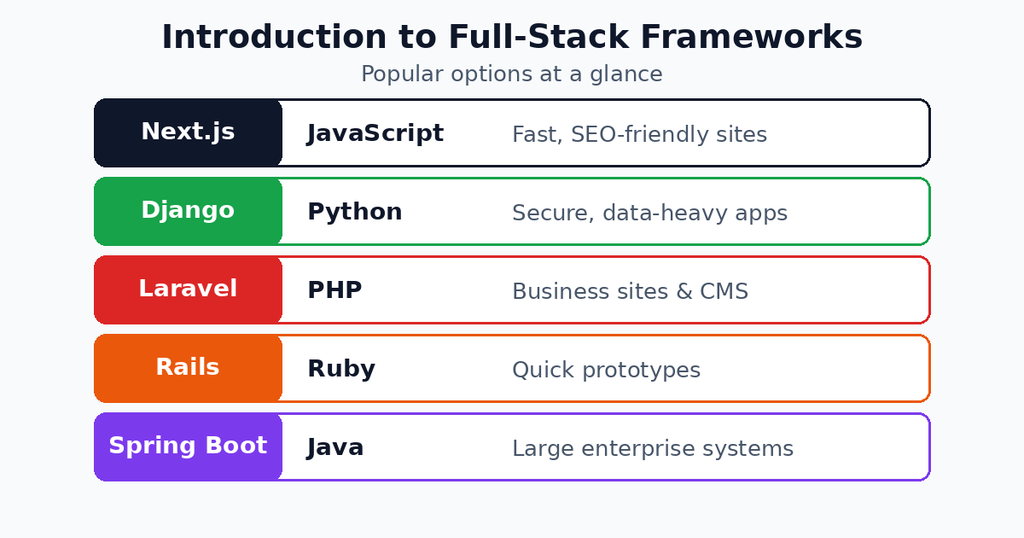
Table of Contents
New to the topic? Read What Is Full-Stack Development? first, and then continue here.
What Are Full-Stack Frameworks?
A full-stack framework is a software package that covers both sides of a web application: what users see and what happens on the server. It usually includes tools for pages, routing, database access, authentication and security, all designed to work together.
Think about building a house. You could cut every brick and mix every bag of cement yourself, or you could start with a prefabricated kit where the walls, pipes and wiring already fit together. Full-stack frameworks are the kit. You still design the house, but the boring and risky parts are already solved.
Some frameworks are truly complete, such as Django and Laravel. Others, such as Next.js, focus on the front end and add back-end features on top. In both cases, the goal is the same: build faster with fewer mistakes.
Why Use Full-Stack Frameworks?
Beginners sometimes ask whether they should just write everything by hand. For real projects, full-stack frameworks offer clear advantages:
- Speed: you skip repeated setup work and reach a working product sooner.
- Structure: a standard folder layout keeps large projects organised.
- Built-in security: good frameworks protect against common attacks such as SQL injection and cross-site scripting by default.
- Consistency: teams write code in the same style, which makes reviews easier.
- Community support: popular frameworks have plenty of tutorials, packages and answers online.
- Easier hiring: companies often look for developers who know a specific framework.
Our guide to Essential Full-Stack Development Skills explains which basics you should know before you start with any framework.
What Is Inside a Full-Stack Framework?
Most full-stack frameworks include the same core parts, even when the names differ.
Routing
Routing connects a URL, such as /products, to the code that handles it. This is the first thing you set up in any project.
Templates or UI Components
This part builds the pages users see. Django and Laravel use templates, while Next.js uses React components.
ORM (Database Layer)
An ORM lets you work with the database using your programming language instead of raw SQL. You define a model, and the framework creates the table and handles queries for you.
Authentication and Authorization
Login, logout, sessions and permissions are already built in or easy to add. This saves a huge amount of time and avoids dangerous mistakes.
Security Tools
Protection against common web attacks, password hashing and request validation usually come ready to use.
Development Tools
Hot reloading, a built-in development server, a testing setup and command-line helpers make daily work smoother.
Here is a small example of how a framework simplifies the database layer. This Django model creates a full table, with no SQL written by hand:
python
from django.db import models

class Task(models.Model):
    title = models.CharField(max_length=200)
    done = models.BooleanField(default=False)
And here is a simple API route in Next.js, which returns JSON:
javascript
export async function GET() {
  const tasks = [{ id: 1, title: "Learn full-stack frameworks" }];
  return Response.json(tasks);
}
Both examples show how little code you need to get a working feature.
Popular Full-Stack Frameworks
Several full-stack frameworks are widely used today. Each fits a different kind of project and language.
(Yahan Image 3 lagao: introduction-to-full-stack-frameworks-comparison.png)
Next.js (JavaScript)
Next.js is built on React and adds server-side rendering, API routes and file-based routing. It is excellent for fast, SEO-friendly websites. See the Next.js documentation to get started.
Django (Python)
Django follows a “batteries included” philosophy. It ships with an admin panel, ORM, authentication and strong security. It is a great choice for data-heavy apps. The Django documentation is widely praised.
Laravel (PHP)
Laravel has elegant syntax and powerful features such as queues, authentication and a simple ORM called Eloquent. It is popular for business websites and content-heavy projects. Start with the Laravel documentation.
Ruby on Rails (Ruby)
Rails popularised the idea of “convention over configuration”. It is perfect for building prototypes and startups quickly. Visit Ruby on Rails for guides.
Spring Boot (Java)
Spring Boot is the standard choice for large enterprise systems. It has a steeper learning curve, but it is stable and widely used in banks and big companies. Read more at Spring Boot.
Full-Stack Frameworks Compared
This table gives a quick comparison.
| Framework | Language | Best for | Learning curve |
|---|---|---|---|
| Next.js | JavaScript | Fast, SEO-friendly sites and web apps | Medium |
| Django | Python | Secure, data-heavy applications | Easy to medium |
| Laravel | PHP | Business sites, CMS and e-commerce | Easy to medium |
| Ruby on Rails | Ruby | Quick prototypes and startups | Medium |
| Spring Boot | Java | Large enterprise systems | Hard |
There is no single best framework. The right choice depends on your language, your project and your career goals.
Frameworks vs Libraries: What Is the Difference?
Beginners often confuse these two terms. A library, such as React, is a collection of tools that you call when you need them. A framework controls the overall structure of your project and calls your code when it needs it.
Full-stack frameworks go one step further than a front-end library. They cover routing, data, authentication and security in one package. If you want to understand how JavaScript fits into this, read our article on JavaScript in Full-Stack Development.
How to Choose Among Full-Stack Frameworks in 7 Easy Steps
Follow this order when you are ready to pick one.
(Yahan Image 2 lagao: introduction-to-full-stack-frameworks-steps.png)
- Understand the basics first. Make sure you know HTML, CSS, JavaScript or one back-end language, and basic databases. Our guide on HTML and CSS for Full-Stack Development is a good starting point.
- Pick a language you enjoy. If you like JavaScript, look at Next.js. If you prefer Python, choose Django. PHP fans can pick Laravel.
- Compare two or three options. Read the official documentation and look at a few example projects for each.
- Choose one and commit. Do not jump between full-stack frameworks every week. Depth matters more than variety.
- Set up your first project. Follow the official “Getting Started” guide and run the development server.
- Build a small app. A to-do list or a blog teaches routing, database models and forms in one project.
- Deploy and improve. Publish your app and add one feature at a time. Our Full-Stack Development Workflow guide explains the whole process.
For a visual learning path, roadmap.sh is a free resource.
A Real-World Example: Building a Blog
Imagine you want to build a personal blog. With a full-stack framework like Django, you define a Post model, and the framework creates the database table and an admin panel where you can write posts. You add a route for the home page and a template that lists the posts. Login is already included, so only you can publish.
Without a framework, you would need to write the database code, the admin interface, the login system and the security checks yourself. That could take weeks. With a framework, a working first version can be ready in a day. This difference is exactly why full-stack frameworks are so popular.
Common Mistakes Beginners Make
Almost everyone makes these mistakes, so it helps to know them early.
- Starting a framework without the basics: weak JavaScript or Python knowledge makes everything harder.
- Framework hopping: switching every few weeks means you never learn one properly.
- Following trends blindly: choose a tool that fits your goals, not the one that is popular this month.
- Copying code without understanding: read the documentation and ask why each part exists.
- Ignoring the documentation: official docs are usually the best tutorial.
- Skipping security settings: never leave debug mode on or secrets in your code.
Best Practices When Working with Frameworks
These habits will keep your projects clean and safe:
- Follow the framework’s recommended folder structure.
- Keep secret keys in environment variables.
- Use the built-in tools for authentication instead of writing your own.
- Write small, reusable components or views.
- Add simple tests for important features.
- Keep your framework and packages updated.
- Commit to Git often, with clear messages.
Practice Projects to Build Your Skills
You learn full-stack frameworks by building, not by reading. Try these in order:
- Personal blog: practise routing, models and templates.
- To-do app with login: practise forms, authentication and database queries.
- Notes app with an API: practise JSON responses and connecting a front end.
- Small online store: practise relationships between products, orders and users.
- Portfolio project: combine everything and deploy it with a custom domain.
Upload each project to GitHub with a clear README. Employers care more about your projects than your certificates.
Frequently Asked Questions
What are full-stack frameworks?
They are toolkits that help you build both the front end and back end of a web application. They provide routing, database access, authentication and security in one organised package.
Which full-stack framework is best for beginners?
Django and Next.js are both beginner-friendly. Choose Django if you like Python, and Next.js if you already know JavaScript.
Do I need to learn a framework to get a job?
Not always, but most companies expect you to know at least one. A framework shows that you can build real, structured applications.
Is Next.js a full-stack framework?
Yes. It started as a React framework, but it now includes API routes, server components and database support, so it can handle both sides of an application.
Should I learn the basics before a framework?
Yes. Learn HTML, CSS, one programming language and basic databases first. A framework makes much more sense when you understand what it is doing for you.
How long does it take to learn a framework?
With regular practice, most beginners can build a simple app in three to four weeks. Becoming comfortable usually takes a few months.
Conclusion
Full-stack frameworks save time, add structure and protect your projects with built-in security. Learn the basics first, then compare two or three options and pick one that matches your language and goals. Follow the seven steps, build small projects and deploy them. Keep practising with full-stack frameworks, and you will soon move from following tutorials to building real applications on your own.