

Full-stack development is the practice of building both the visible part of a website and the hidden machinery that makes it work. If you have ever shopped on an online store, logged in to a social app or booked a ticket on a website, you have used the result of full-stack development without noticing it.
This guide explains what full-stack development means, how its layers fit together, which skills and tools you need, and how a complete beginner can start learning it step by step.
Table of Contents
What Is Full-Stack Development?
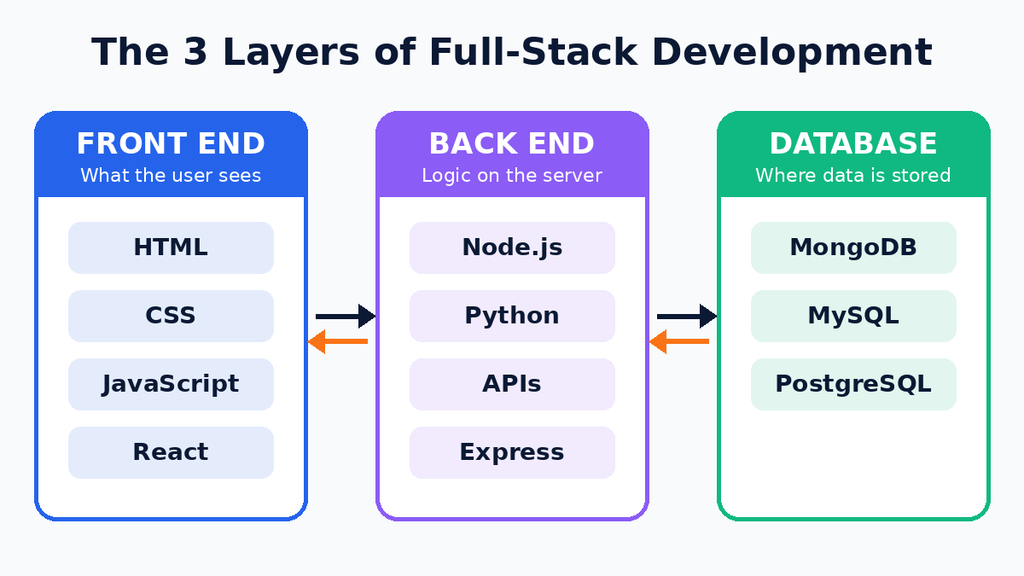
Full-stack development means working on the complete “stack” of a web application. That stack has three parts: the front end (what users see), the back end (the logic running on a server) and the database (where information is stored). A developer who can work on all three is called a full-stack developer.
The word “stack” simply means a group of technologies that work together. One project may use HTML, CSS and JavaScript for the screen, Node.js for the server and MongoDB for data. Another project may use Python with PostgreSQL.https://www.w3schools.com/whatis/whatis_fullstack.asp
Companies like full-stack development because one person can understand the whole product. Planning becomes faster, and there are fewer misunderstandings between teams. If you want a closer look at the job itself, read our guide on the Role of a Full-Stack Developer.
The Three Layers of Full-Stack Development
Every web application you use is built from the same three layers. Understanding them is the first real step into full-stack development.
Front End: What the User Sees
The front end is everything that appears in the browser: buttons, menus, forms, colours and animations. It is built mainly with three languages:
- HTML gives the page its structure.
- CSS controls the design, colours and layout.
- JavaScript makes the page interactive.
Most modern projects also use a framework such as React, Angular or Vue to build screens faster. If you are new, the free MDN Web Docs learning area is the best place to practise these basics.
Back End: The Brain of the Application
The back end runs on a server that the user never sees. It receives requests from the front end, applies rules, talks to the database and sends a response back. Login checks, payment processing and search results all happen here.
Popular back-end languages include JavaScript (Node.js), Python, Java and PHP. Developers also build APIs, which are the doors that let the front end and back end talk to each other. We explain this connection in detail in our post on Front-End and Back-End Integration.
Database: The Memory of the Application
A database stores user accounts, orders, messages and every other piece of data the app needs. There are two main types:
- SQL databases such as MySQL and PostgreSQL store data in tables with rows and columns.
- NoSQL databases such as MongoDB store data as flexible documents.
Choosing between them depends on the project. Structured data like bank records suits SQL, while flexible data like social media posts often suits NoSQL.
How Full-Stack Development Works: A Simple Example
Let us follow one action: a user logs in to a website.
- The user types an email and password into a form. This form is built on the front end.
- When the user clicks “Login”, the browser sends the details to the server through an API request.
- The back end receives the request and checks the details against the database.
- If the details match, the server sends back a success message and a secure token.
- The front end shows the user’s dashboard.
This whole journey takes less than a second, yet it touches every layer. A person skilled in full-stack development can build, test and fix each of these steps.
Core Skills Needed for Full-Stack Development
You do not need to master everything on day one. A solid foundation looks like this:
- HTML, CSS and JavaScript: the base of every website.
- A front-end framework: React is the most common choice for beginners.
- A back-end language and framework: for example Node.js with Express, or Python with Django.
- Databases: basic SQL and one NoSQL database.
- APIs: understanding REST and how to send and receive JSON data.
- Git and GitHub: for saving versions of your code and working in teams.
- Basic security: password hashing, input validation and safe authentication.
- Problem solving: breaking a big feature into small tasks and debugging calmly.
Our article on Essential Full-Stack Development Skills goes deeper into each of these.
Popular Stacks Used in Full-Stack Development
A tech stack is a ready-made combination of tools. The table below compares the most popular ones.
| Stack | Technologies | Best for |
|---|---|---|
| MERN | MongoDB, Express, React, Node.js | Modern single-page apps |
| MEAN | MongoDB, Express, Angular, Node.js | Large, structured applications |
| LAMP | Linux, Apache, MySQL, PHP | Websites and WordPress-style projects |
| Python stack | Django or Flask, PostgreSQL, React | Data-driven and AI-related apps |
For beginners, MERN is a popular starting point because you use JavaScript on both the front end and the back end. That means one language to learn instead of two.
Essential Tools Every Beginner Should Know
Good tools save hours of work. These are the ones you will use again and again:
- VS Code: a free code editor with thousands of extensions.
- Git and GitHub: version control and a public portfolio.
- Postman: for testing your APIs without building a front end first.
- Browser DevTools: for inspecting and debugging web pages.
- Hosting platforms: such as Vercel, Netlify and Render, which let you put your project online.
Benefits and Challenges of Full-Stack Development
Like any career path, full-stack development has strong points and difficult points.
Benefits
- You can build a complete project on your own, from idea to launch.
- You see the big picture, which makes you valuable in startups and small teams.
- The skills are flexible, so you can move between front-end, back-end and freelance work.
- Strong demand exists for developers who understand the whole product.
Challenges
- The learning list is long, and technology keeps changing.
- It is easy to become average at many things instead of strong at a few.
- Beginners often feel overwhelmed by too many frameworks.
The fix is simple: learn one stack deeply first, build projects, and add new tools only when a project needs them.
Career Paths in Full-Stack Development
Once you have a few projects, several paths open up:
- Junior full-stack developer at a software company or startup.
- Freelance web developer building websites for clients.
- Front-end or back-end specialist, if you later prefer one side.
- Software engineer or DevOps engineer, with extra experience.
According to the Stack Overflow Developer Survey, JavaScript, SQL and Python remain among the most widely used languages, which shows how useful these skills are across the industry.
How to Start Learning Full-Stack Development
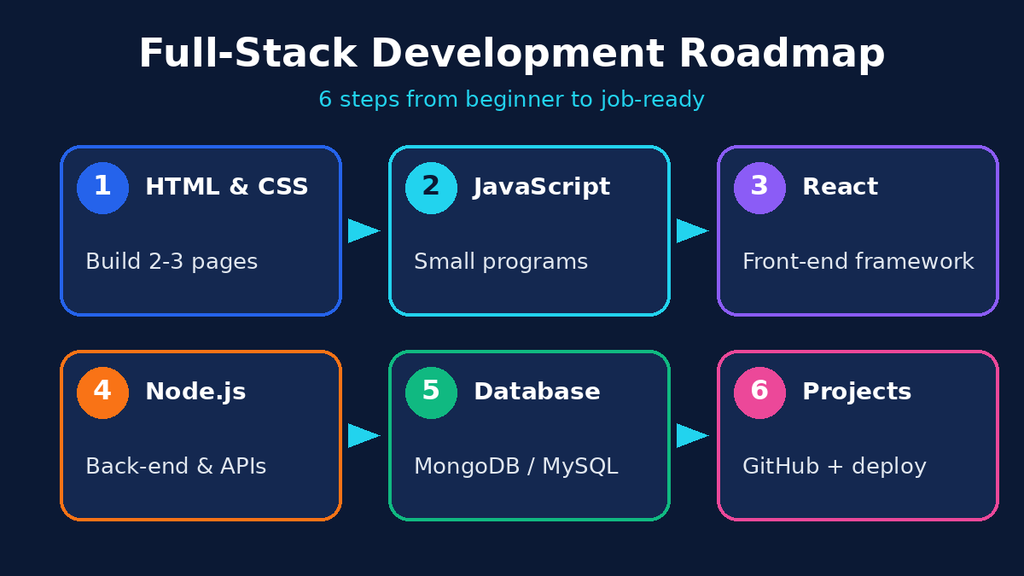
Follow this simple roadmap:
- Learn HTML and CSS. Build 2 or 3 simple pages, such as a profile page and a landing page.
- Learn JavaScript. Practise with small programs like a calculator or a to-do list.
- Pick one front-end framework. React is a safe choice.
- Learn a back-end language. Node.js is easiest if you already know JavaScript.
- Connect a database. Start with MongoDB or MySQL and build a basic login system.
- Build and publish projects. Put your code on GitHub and deploy it online.
Consistency matters more than speed. One hour of coding every day beats ten hours once a month. When you are ready for a bigger project, our guide on Building a Full-Stack Web Application walks you through the process.
Frequently Asked Questions
Is full-stack development hard for beginners?
It feels big at the start, but it becomes manageable when you learn in small steps. Begin with HTML, CSS and JavaScript, then add one new layer at a time.
How long does it take to learn full-stack development?
Most beginners need around 6 to 12 months of regular practice to become job-ready. The time depends on how many hours you study and how many real projects you build.
Which language is best for full-stack development?
JavaScript is the easiest choice because it works on both the front end and the back end. Python and Java are also strong options.
Do I need a degree to become a full-stack developer?
No. A degree helps, but employers mostly look at your projects, GitHub profile and problem-solving ability.
Conclusion
Full-stack development brings the front end, back end and database together so that one person can build a complete web application. Start with the basics, choose one stack, build real projects and publish them. Step by step, you will move from beginner to a confident developer.