

Full-stack development skills are the combination of front-end, back-end, database, and deployment abilities that allow one developer to build a complete web application from scratch. In 2026, companies want people who understand the whole journey of a feature: how it looks in the browser, how it talks to the server, and how its data is stored safely. That is exactly why full-stack roles keep appearing at the top of job boards.
But there is a problem. Most beginners see a giant list of technologies and have no idea where to begin. Should you learn React first or Node.js? Do you need Docker on day one? This guide cuts through the noise. You will learn which skills truly matter, why they matter, and the order in which to build them.
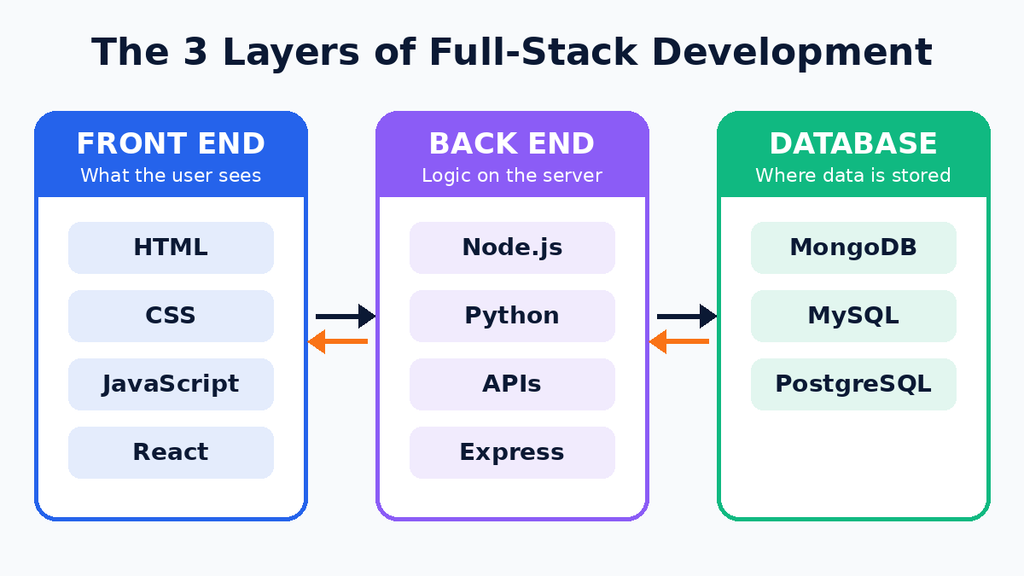
Table of Contents
What Are Full-Stack Development Skills?
A full-stack developer works on both the client side (what users see) and the server side (what users never see). So full-stack development skills cover everything between the browser and the database.
Think of a restaurant. The front end is the dining area, the menu, and the table service. The back end is the kitchen. The database is the pantry. A full-stack developer can work in all three areas and, more importantly, understands how they connect. If you want a deeper introduction first, read our guide on What Is Full-Stack Development? before continuing.
Front-End Skills: Building What Users See
The front end is everything a visitor touches: buttons, forms, menus, and animations. Strong front-end skills make a website feel fast and easy to use.
HTML and CSS
HTML gives a page its structure, while CSS controls its look. These two are the foundation of every website, so never skip them. Learn semantic tags like <header>, <main>, and <article>, then practice Flexbox and CSS Grid for layouts. The MDN Web Docs are the best free place to learn both properly.
JavaScript
JavaScript makes pages interactive. It handles clicks, form validation, and live updates without reloading the page. Focus on variables, functions, arrays, objects, the DOM, promises, and async/await. Modern JavaScript (ES6 and beyond) is non-negotiable, because every framework builds on it.
Front-End Frameworks
Once JavaScript feels comfortable, pick one framework. React is the most in-demand choice, while Vue and Angular are also solid. A framework helps you build reusable components and manage complex interfaces without writing the same code again and again. Learn one deeply instead of three shallowly.
Responsive Design and Accessibility
More than half of web traffic comes from phones, so your layouts must adapt to every screen. Use media queries and a mobile-first approach. Accessibility matters just as much: add alt text, use proper contrast, and make sure the site works with a keyboard. These habits make you a better full-stack developer and help real users.
Back-End Skills: Powering the Server Side
The back end handles logic, authentication, and communication with the database. When you log in to an app, the back end checks your password and decides what you can see.
A Server-Side Language
You need at least one back-end language. Popular choices include JavaScript (Node.js), Python, Java, PHP, and C#. If you already know JavaScript, Node.js is the smoothest path because you use one language across the whole stack. Python is another friendly option with frameworks like Django and Flask.
Back-End Frameworks
Frameworks save time by giving you routing, middleware, and structure out of the box. Express.js for Node, Django for Python, and Spring Boot for Java are all widely used. Learn how requests and responses flow, how middleware works, and how to organise your project folders cleanly.
Authentication and Authorization
Authentication proves who a user is. Authorization decides what that user can do. Learn sessions, cookies, JSON Web Tokens (JWT), and password hashing. Almost every real application needs these, so they are core full-stack development skills, not optional extras.
Database Skills: Storing and Retrieving Data
Every serious application stores data, whether it is users, orders, or blog posts. A full-stack developer must know how to design and query a database.
SQL Databases
Relational databases like MySQL and PostgreSQL store data in tables with relationships. Learn how to write SELECT, INSERT, UPDATE, and DELETE queries, plus joins, indexes, and normalization. SQL is a skill that lasts an entire career.
NoSQL Databases
MongoDB and similar tools store flexible, document-style data. They suit projects where the data structure changes often. Knowing both SQL and NoSQL lets you choose the right tool instead of using one for everything.
Data Modeling
Before writing code, sketch how your data connects. A user has many orders, an order has many items, and so on. Good data modeling prevents painful rewrites later and keeps your application fast.
Version Control with Git and GitHub
Git tracks every change you make to your code. If something breaks, you can go back to a working version in seconds. It also lets teams work together without overwriting each other.
Start with the basics: git init, git add, git commit, git push, and git pull. Then learn branches and pull requests. Host your projects on GitHub so employers can see your work. The official Git documentation is a reliable reference when you get stuck.
APIs and Integration Skills
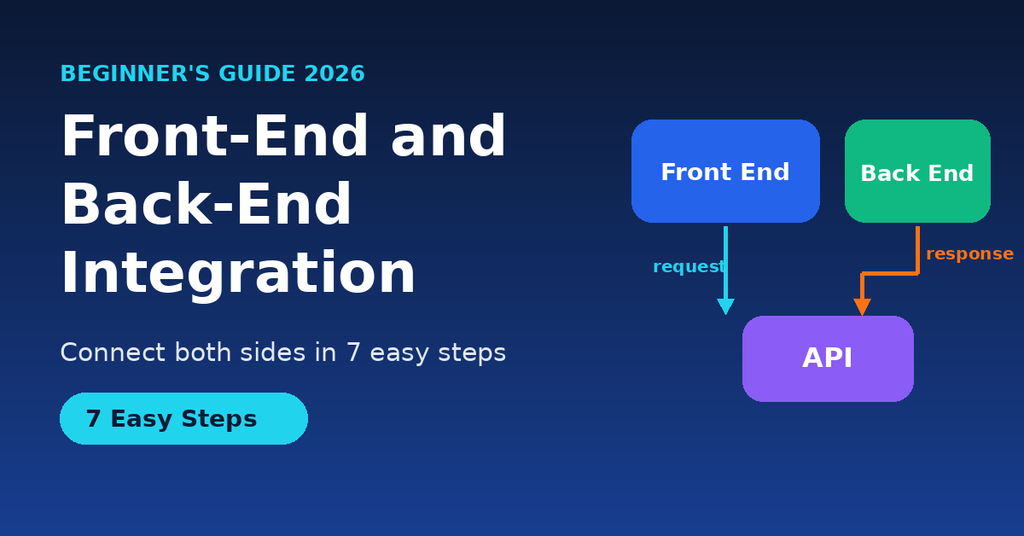
APIs are the bridge between the front end and the back end. A front-end form sends data to an API, the server processes it, and the response comes back to the screen.
Learn REST principles first: endpoints, HTTP methods (GET, POST, PUT, DELETE), status codes, and JSON. Then explore tools like Postman to test your endpoints. Later, GraphQL is worth a look. To see how both sides work together in practice, our article on Front-End and Back-End Integration walks through the full process.
Security Skills Every Developer Must Know
Security is not only for specialists. A single weak login form can expose thousands of users. Every full-stack developer should understand these basics:
- Input validation: Never trust data from the user.
- SQL injection and XSS: Learn how these attacks work and how to prevent them.
- HTTPS: Always encrypt traffic between browser and server.
- Password storage: Hash passwords with bcrypt or Argon2, never store plain text.
- Environment variables: Keep API keys and secrets out of your code.
The OWASP Top 10 lists the most common web vulnerabilities and is a great starting point.
Testing and Debugging Skills
Writing code is only half the job. Finding and fixing bugs is the other half. Learn to use browser developer tools, read error messages calmly, and add logging to trace problems.
Testing is just as valuable. Unit tests check small pieces of code, integration tests check how parts work together, and end-to-end tests simulate a real user. Tools like Jest and Cypress are popular choices. Developers who test their code are trusted with bigger responsibilities.
Deployment and DevOps Basics
A project sitting on your laptop helps nobody. Deployment means putting your application on the internet where people can use it.
Begin with simple platforms such as Vercel, Netlify, or Render. Then learn the basics of Linux commands, domain names, and SSL certificates. As you grow, explore Docker for packaging your app and CI/CD pipelines for automatic testing and deployment. You do not need to be a DevOps expert, but understanding the process makes you far more valuable. We cover this journey in detail in our Full-Stack Development Workflow guide.
Soft Skills That Set You Apart
Technical ability gets you interviews, but soft skills help you keep the job and grow.
- Problem-solving: Break big problems into small, manageable steps.
- Communication: Explain technical ideas clearly to teammates and non-technical clients.
- Time management: Estimate tasks honestly and meet deadlines.
- Continuous learning: Technology changes fast, so curiosity is a real advantage.
- Teamwork: Accept code reviews gracefully and give helpful feedback.
Full-Stack Development Skills at a Glance
| Skill Area | Key Technologies | Priority |
|---|---|---|
| Front End | HTML, CSS, JavaScript, React | Essential |
| Back End | Node.js, Express, Python, Django | Essential |
| Databases | MySQL, PostgreSQL, MongoDB | Essential |
| Version Control | Git, GitHub | Essential |
| APIs | REST, JSON, Postman | Essential |
| Security | HTTPS, JWT, OWASP basics | High |
| Testing | Jest, Cypress | High |
| Deployment | Vercel, Docker, CI/CD | Medium |
How to Learn Full-Stack Development Skills Step by Step
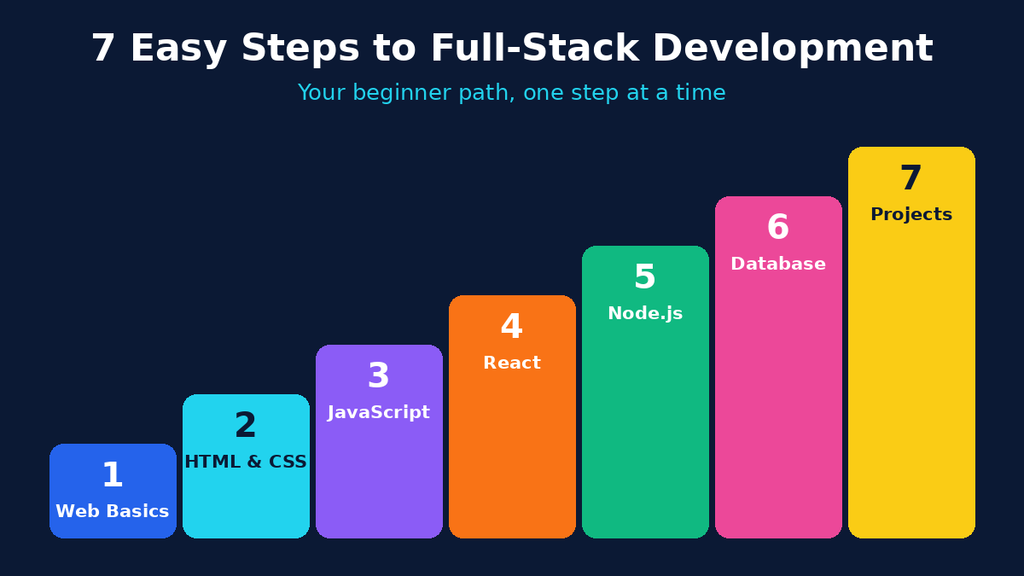
Trying to learn everything together leads to burnout. Follow this order instead:
- Months 1–2: HTML, CSS, and basic JavaScript. Build a simple portfolio page.
- Months 3–4: Advanced JavaScript and a framework like React. Build a to-do app.
- Months 5–6: Node.js, Express, and a database. Build a login system with a REST API.
- Months 7–8: Git, testing, security basics, and deployment. Publish a complete project online.
- Ongoing: Build real projects, read other people’s code, and contribute to open source.
For a structured path, roadmap.sh offers a free visual guide, and freeCodeCamp gives hands-on lessons at no cost. Remember that projects teach more than tutorials. Employers care about what you have built, not how many courses you finished.
Frequently Asked Questions
How long does it take to learn full-stack development skills?
With consistent practice of 2–3 hours daily, most beginners reach a job-ready level in 8 to 12 months. The timeline depends on your background and how many real projects you build.
Do I need a degree to become a full-stack developer?
No. A degree helps, but many successful developers are self-taught. A strong portfolio, GitHub activity, and solid fundamentals matter more to most employers.
Which programming language should I learn first?
Start with JavaScript. It works on both the front end and back end, so you can build a complete application using a single language.
Is full-stack development still in demand?
Yes. Startups and small teams especially value developers who can handle multiple layers of a project, which keeps demand strong.
Conclusion
Mastering full-stack development skills is a journey, not a weekend task. Start with the fundamentals of HTML, CSS, and JavaScript, then move into back-end logic, databases, Git, security, and deployment. Add soft skills along the way, because they multiply the value of your technical knowledge.
Pick one small project today, such as a notes app or a simple blog, and start building. Every line of code you write brings you closer to becoming a confident full-stack developer.