

By the end of this introduction to full-stack development, you will know what the field covers, how a web request travels from your browser to a server and back, which skills to learn first, and what to do in your first three months. No experience is needed to follow along.
If you want a quick definition before you begin, read our post on Full-Stack Development Explained first. This article goes one step further and gives you a practical starting plan.
Table of Contents
Introduction to Full-Stack Development: The Basics
Full-stack development is the skill of building a complete web application from start to finish. That includes the screens people see, the server that handles requests and the database that stores information. A developer who works across all of these areas is called a full-stack developer.
The easiest way to understand it is to imagine a restaurant:
- The dining room is the front end. It is what customers see and touch.
- The kitchen is the back end. It prepares what the customer asked for.
- The storeroom is the database. It keeps all the ingredients safe and organised.
- The waiter is the API. It carries requests to the kitchen and brings the food back.
A full-stack developer is like a restaurant owner who can cook, serve and manage the storeroom. They may not be the best at every single job, but they understand how the whole place runs. This is the core idea behind any introduction to full-stack development.
Why Learn Full-Stack Development in 2026?
Any good introduction to full-stack development should explain why the skill is worth your time. Learning full-stack development gives you more options than learning only one side of the web. Here is why many beginners choose it:
- You can build your own ideas. With front-end, back-end and database skills, you do not need a big team to launch a small product.
- Freelancing becomes easier. Clients often want one person who can deliver a complete website or web app.
- Startups value flexible developers. Small teams need people who can switch between different tasks.
- You understand the whole picture. This makes you better at fixing bugs, because you know where a problem could come from.
- It builds a strong base. Later you can specialise in front end, back end, cloud or security.
A Short History of How the Web Grew
To appreciate this introduction to full-stack development, it helps to know where the web started. The first websites in the early 1990s were simple pages of text and links. Every visitor saw the same page, and nothing changed unless the owner edited the file by hand.
Later, languages such as PHP made it possible for websites to create pages on the fly and store data in databases. This is how online shops, forums and login systems became possible. In 2009, Node.js allowed developers to run JavaScript on the server, which meant one language could now power both sides of an app.
Today, tools like React, Express and cloud hosting make it easier than ever to build complete applications. That is why a modern introduction to full-stack development can start with JavaScript alone and still lead to a real project.
How the Web Works: A Beginner’s Introduction to Full-Stack Development
Before writing any code, you should understand what happens when someone opens a website. Here is the journey in six steps:
- You type a web address into your browser and press Enter.
- The browser finds the server that hosts the website.
- The browser sends a request, asking for a page or for some data.
- The server runs back-end code and, if needed, asks the database for information.
- The server sends a response, usually HTML or data in JSON format.
- The browser shows the result on your screen.
Every feature you will ever build follows this same loop. A login button, a shopping cart and a comment box are all variations of request and response. Once this idea is clear, the rest of full-stack development feels much less scary.
The Three Layers in Plain Words
Every introduction to full-stack development covers the same three layers, so let us look at each one in simple language.
Front End
The front end is built with HTML, CSS and JavaScript. HTML creates the structure, CSS adds the design and JavaScript adds behaviour, such as menus that open or forms that check your input. Frameworks like React help you organise larger interfaces.
Back End
The back end is the logic that runs on the server. It checks passwords, calculates totals, sends emails and decides what data a user is allowed to see. You can write it in Node.js, Python, Java, PHP or other languages.
Database
The database stores information permanently. Relational databases like MySQL and PostgreSQL use tables, while MongoDB stores flexible documents. A beginner can start with either one, as long as they practise saving, reading, updating and deleting data. These four actions are known as CRUD, and almost every app uses them.
Skills and Tools to Learn First
A smart introduction to full-stack development never asks you to learn everything at once. This table shows what to learn first and what can wait.
| Area | Learn first | Learn later |
|---|---|---|
| Front end | HTML, CSS, JavaScript | React, TypeScript |
| Back end | Node.js and Express | Authentication, caching |
| Database | Basic SQL or MongoDB | Indexing, performance tuning |
| Tools | VS Code, Git, GitHub | Docker, CI/CD |
| Extras | Browser DevTools, Postman | Cloud hosting, testing |
The free MDN Learn Web Development course is a trusted place to practise the front-end basics, and the official Git website has everything you need to start with version control.
Your Introduction to Full-Stack Development: 7 Easy Steps
Follow these steps in order. Each one builds on the one before it, and together they turn this introduction to full-stack development into a real learning plan.
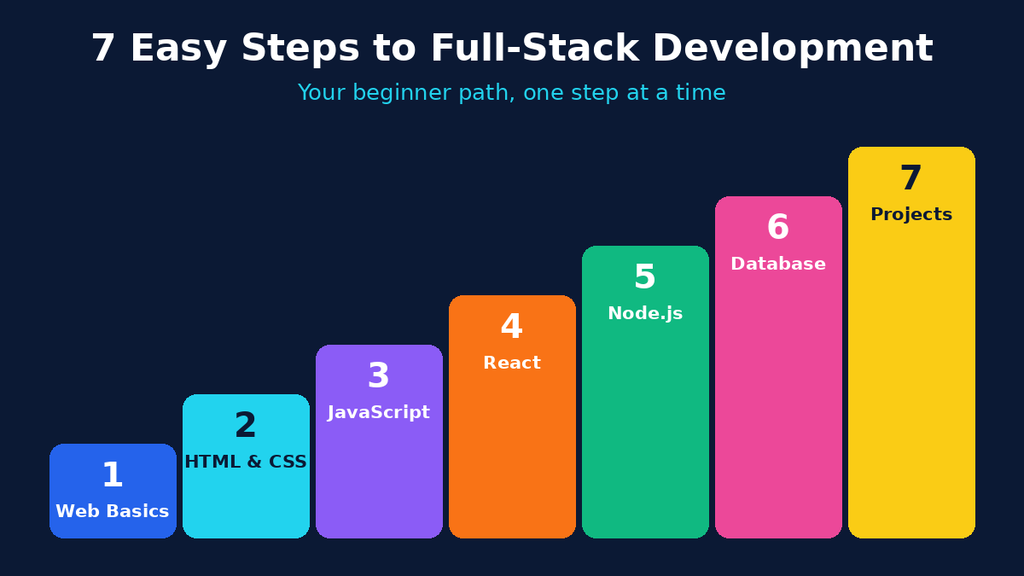
- Learn how the web works (1 week). Read about requests, responses, browsers and servers. The six-step journey above is enough to begin.
- Master HTML and CSS (3 to 4 weeks). Build a personal profile page and a simple landing page. Focus on layout and on making your pages look good on mobile.
- Learn JavaScript (6 to 8 weeks). Practise variables, functions, loops, arrays and the DOM. Create small tools like a calculator and a to-do list.
- Pick one front-end framework (4 weeks). React is a safe choice because it has a huge community and many free tutorials.
- Learn a back-end language (4 to 6 weeks). If you already know JavaScript, Node.js with Express is the smoothest path. Build a simple API that returns data.
- Connect a database (3 to 4 weeks). Save users and posts in MongoDB or MySQL and build a basic login system.
- Build, publish and share (ongoing). Upload your code to GitHub, deploy your projects online and keep improving them.
These timelines are only a guide. If you study one or two hours every day, your progress will add up quickly.
Beginner Project Ideas
Projects teach you more than videos do, and no introduction to full-stack development is complete without them. Here are five ideas that fit this stage:
- Personal portfolio website with a contact form.
- To-do app with login, where each user sees only their own tasks.
- Notes app that saves, edits and deletes notes in a database.
- Blog with an admin panel to create and manage posts.
- Mini online store with a product list and a shopping cart.
Each project covers the front end, back end and database, which is the whole point of a practical introduction to full-stack development. To see how the pieces connect in a larger build, check our guide on Building a Full-Stack Web Application.
Common Mistakes Beginners Make
The biggest mistake in any introduction to full-stack development is trying to go too fast. Avoid these common traps:
- Jumping into frameworks too early. Learn plain JavaScript first, otherwise React will feel like magic that you cannot debug.
- Watching tutorials without building. Pause the video and write the code yourself.
- Learning too many languages at once. Pick one stack and stay with it for several months.
- Ignoring Git. Save your work to GitHub from your very first project.
- Skipping security basics. Never store plain-text passwords, and always validate what users type into forms.
Common Myths About Full-Stack Development
- Myth: You must know everything. Reality: nobody knows every tool. You need strong basics and the ability to keep learning.
- Myth: It is only for people with a computer science degree. Reality: many developers are self-taught and prove their skills with projects.
- Myth: Full-stack developers are experts at everything. Reality: most have a stronger side and a weaker side, and that is completely normal.
- Myth: It is too late to start. Reality: the web keeps growing, and new beginners start every single day.
Front-End, Back-End or Full-Stack: Which Path Should You Choose?
If you love design and user experience, begin with front-end development. If you enjoy logic, data and problem solving, back-end development may suit you better. If you like seeing a whole product come to life, full-stack development is a great fit.
The good news is that this introduction to full-stack development works for all three paths, so you do not have to decide on day one. The first steps of the roadmap above are the same for all three paths, so you can start now and choose later.
What Can You Do After Learning It?
After this introduction to full-stack development and your first few projects, you can apply for junior developer or internship roles, start freelancing on small websites or keep building your own product. You can also grow into specialised roles such as front-end engineer, back-end engineer or DevOps engineer. For details about daily work, see our post on the Role of a Full-Stack Developer.
Frequently Asked Questions
What is the best way to start an introduction to full-stack development?
Start with HTML, CSS and JavaScript, then add a back-end language and a database. Build a small project at every stage so the ideas stay fresh in your mind.
Is an introduction to full-stack development enough to get a job?
It is a strong start, but employers also want to see projects. Finish the roadmap, build two or three complete apps and share them on GitHub to show real skills.
Do I need to know maths or coding before I begin?
No. Basic computer skills and patience are enough. You will learn programming logic as you go.
Is full-stack development still worth learning in 2026?
Yes. Websites and web apps are everywhere, and employers and clients still need people who can build and maintain them.
How many hours a day should a beginner study?
One to two focused hours a day is enough if you stay consistent and build projects along the way.
Conclusion
This introduction to full-stack development showed you that the field is simply the skill of building the front end, back end and database of a web application. Start with the basics of the web, learn one stack, build small projects and publish them. Every step you finish makes the next one easier, and this introduction to full-stack development is your first one.https://www.mongodb.com/resources/basics/full-stack-development